- All
- Hot stars
- eruptive stars
- Pulsating stars
- Young stars
- Spectral classes
- Other objects
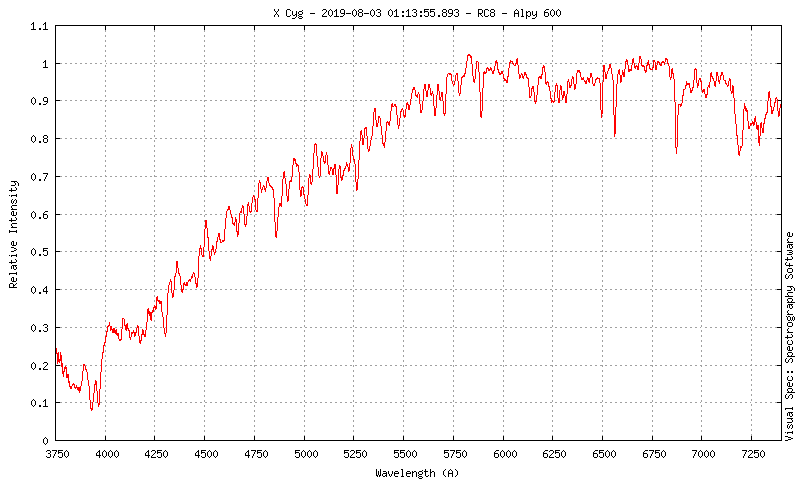
X Cyg
A classical Cepheid (F–G supergiant) in Cygnus, pulsating with a period of about 16.4 days. At low resolution its spectral type visibly changes over the pulsation cycle (Balmer and metal lines strengthening or weakening), and a small Doppler shift of the lines traces the motion of its pulsating surface — a textbook case of the period–luminosity relation that underpins the cosmic distance ladder.
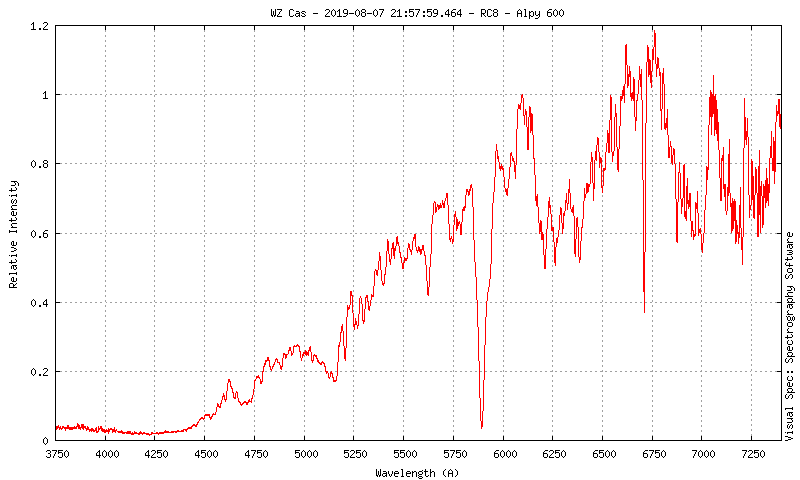
WZ Cas
A semi-regular carbon (type C) star in Cassiopeia, with an intense red colour. Its low-resolution spectrum is dominated by broad molecular carbon absorption bands (C2 Swan bands, CN), quite different from the titanium-oxide bands of ordinary red giants — an immediate signature of a carbon-enriched atmosphere, the result of fusion products dredged up from the star’s interior.
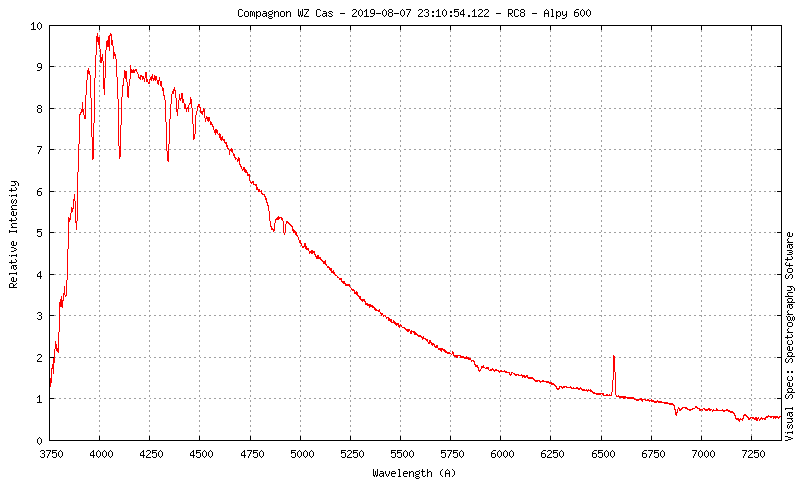
Tycho 40141381 – HD224869 – WZ Cas companion
Likely the catalogue designation (Tycho-2, TYC 4014-1381-1) of HD 224869, the visual companion of WZ Cas: a B2ne-type Be star, separated by 58″, with no established physical link to the carbon star (radial-velocity difference of about 20 km/s, no common proper motion). Its low-resolution spectrum shows emission on Hα, Hβ and Hγ, the classic signature of a circumstellar disc — so it is not just a field star, but a genuine Be target worth observing alongside WZ Cas.
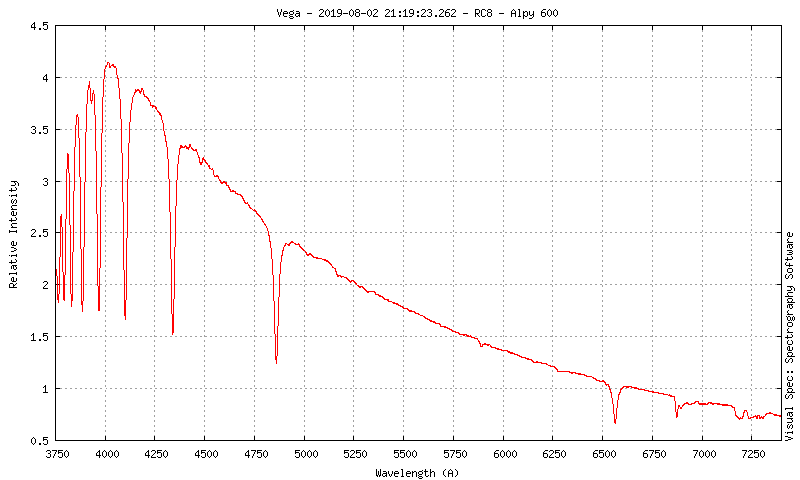
Vega
The A0V standard star, a historical reference for spectral classification and photometric calibration (long used as the zero point of the magnitude scale). Its low-resolution spectrum is a textbook case: an almost featureless continuum crossed by the broad hydrogen Balmer absorption lines, with no strong metal lines. It is commonly used to calibrate an instrument’s response.
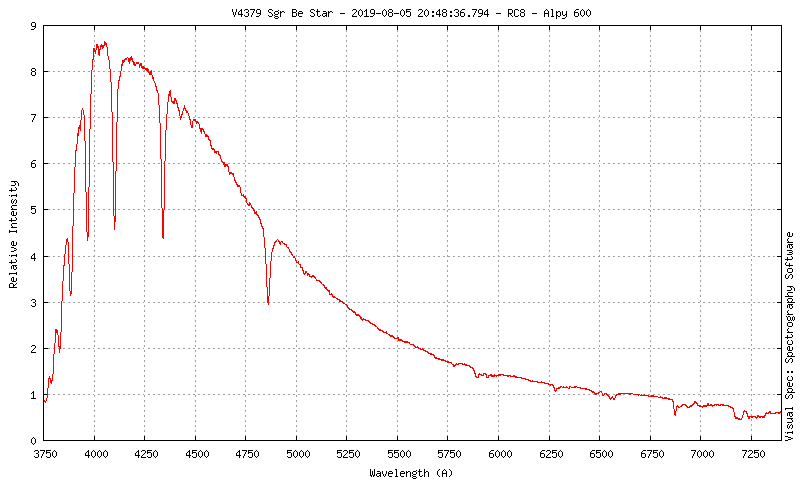
V4379 Sgr - HD165202
A Be star in Sagittarius, monitored by amateur networks that track Hα emission in Be stars. Like all classical Be stars, its low-resolution spectrum shows Hα in emission, produced by a disc of gas shed from the equator of the rapidly rotating star; the strength and shape of this line evolve as the disc forms and dissipates, making it a rewarding target for long-term spectroscopic monitoring.
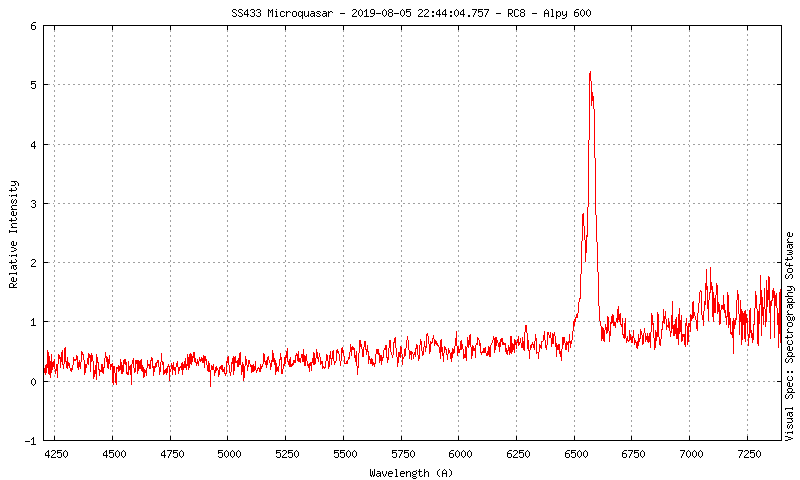
SS433
A microquasar in Aquila: a binary star hosting a compact object (neutron star or black hole) that ejects two precessing relativistic jets at about a quarter of the speed of light. Even at low resolution, its emission lines (notably Hα) split and shift dramatically from one spectrum to the next under the Doppler effect of the jets — one of the few objects where an amateur spectrum can literally “watch” a relativistic jet move.
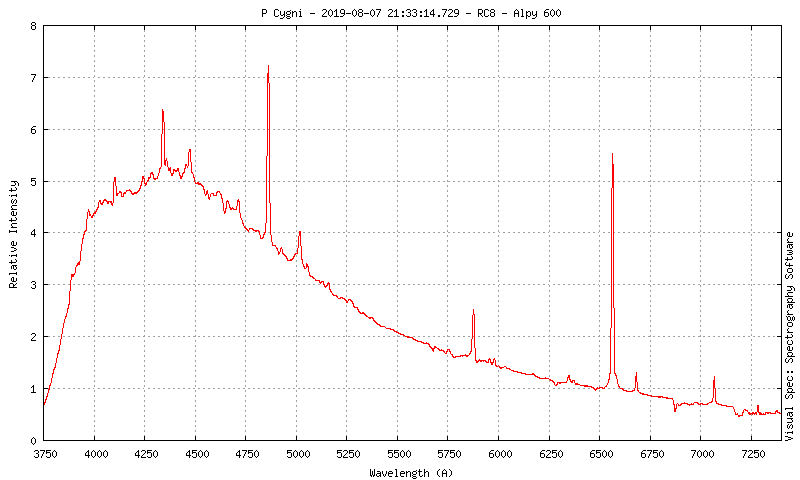
P Cygni
A luminous blue variable (LBV) in Cygnus, a hypergiant undergoing intense mass loss. It lends its name to the “P Cygni profile”: an emission line paired with a blue-shifted absorption component, the signature of an expanding stellar wind. Clearly visible at low resolution on Hα, it is the textbook reference example for this type of line profile.
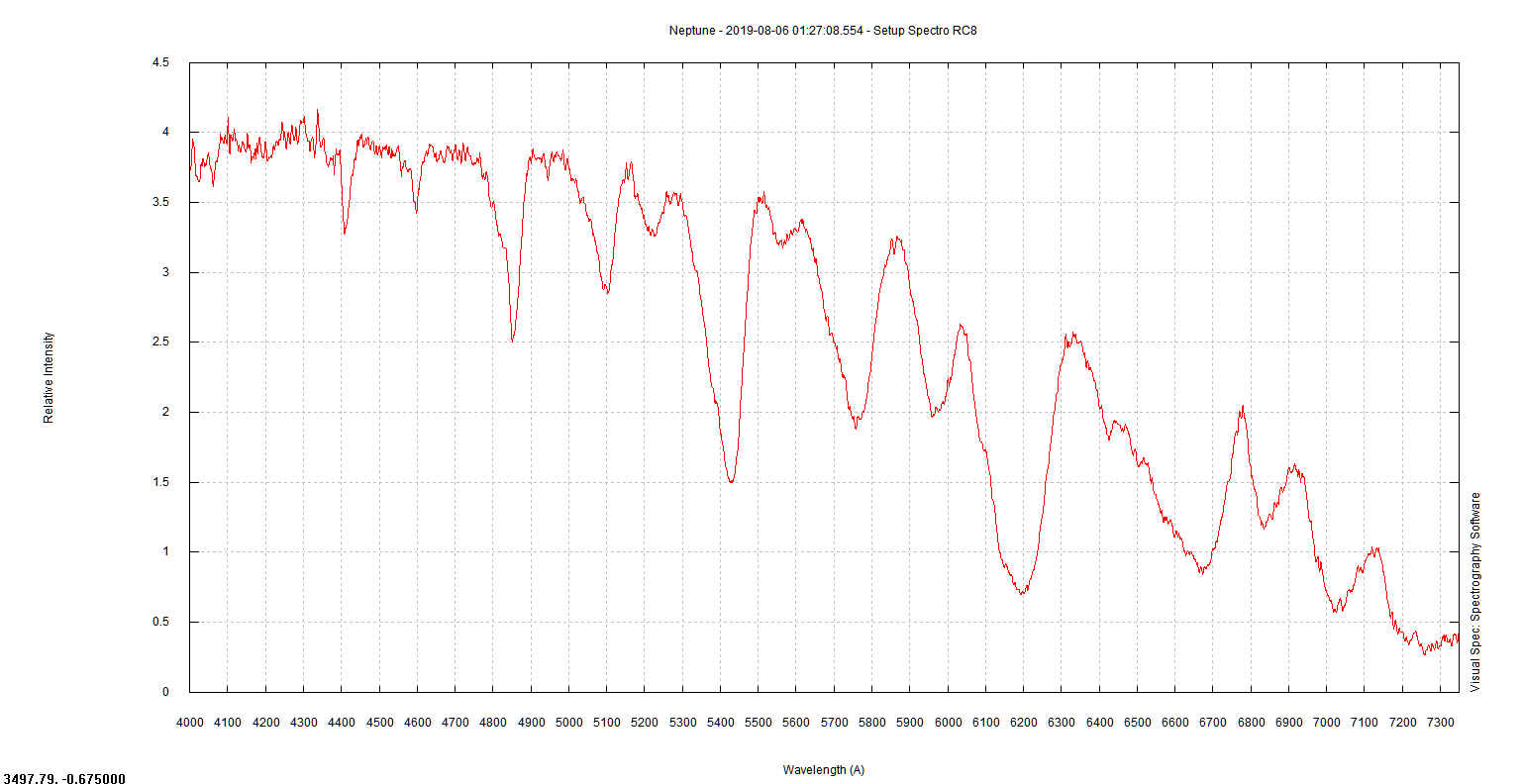
Neptune
An ice giant planet whose low-resolution spectrum is not its own light but reflected sunlight, heavily reshaped by deep methane (CH4) absorption bands in the red and near-infrared. This absorption is what gives Neptune its characteristic blue colour — a nice illustration of planetary spectroscopy within reach of amateur equipment.
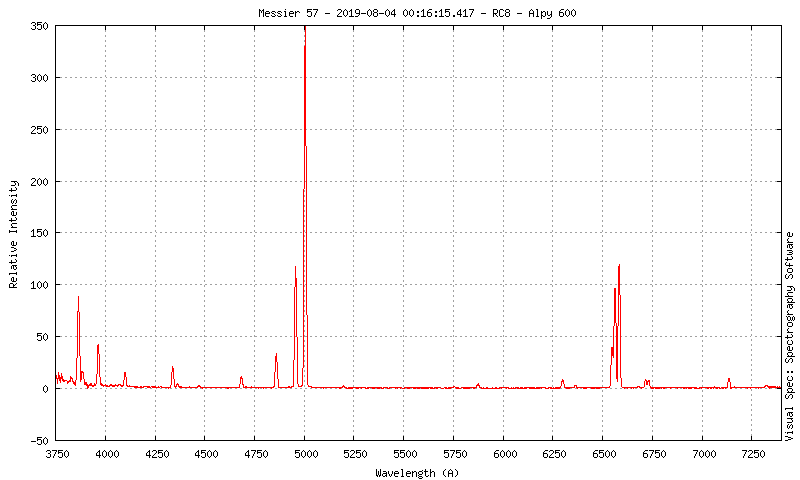
M57
The Ring Nebula, a planetary nebula in Lyra: the gaseous remnant of a Sun-like star, ionized by its hot residual core (a forming white dwarf). Its low-resolution spectrum is dominated by strong forbidden emission lines of doubly ionized oxygen ([OIII] at 495.9 and 500.7 nm) and by Hβ, typical of photoionized planetary nebulae.
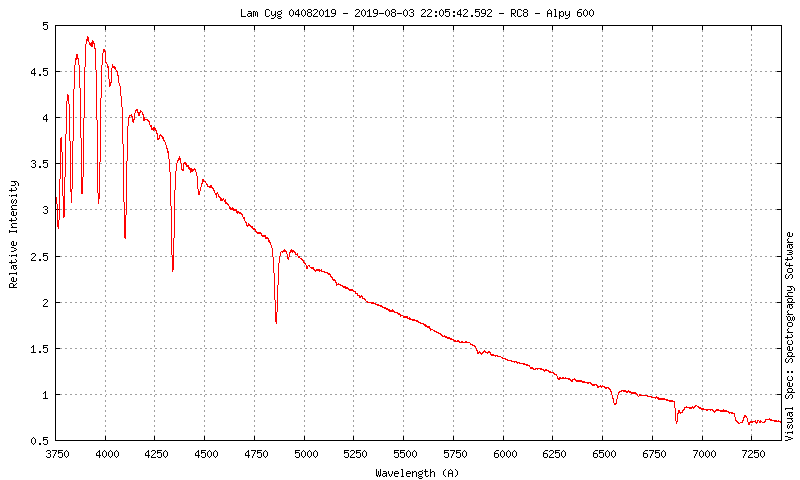
Lam Cyg
A Be star (B5Ve) in Cygnus, spinning very rapidly and surrounded by a disc of material ejected from its equator. Its low-resolution spectrum shows Hα in emission, the classic Be-star signature, whose strength and shape vary with the state of the circumstellar disc. It is also a hierarchical multiple system with at least six components, including a spectroscopic binary.
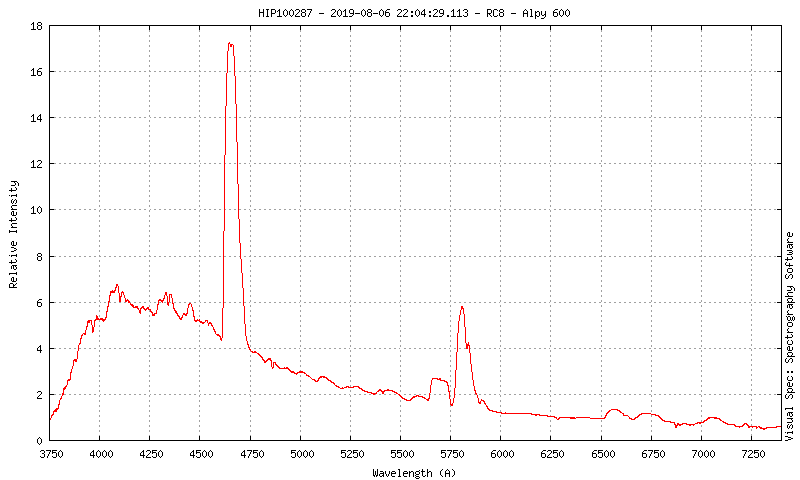
HD193793 - WR140
A WC7-type Wolf-Rayet star in a colliding-wind binary with an O-type companion, on a highly eccentric 7.94-year orbit. Its low-resolution spectrum is dominated by broad carbon emission lines (CIII/CIV), and the periodic collision of the two stellar winds episodically produces carbon dust, forming the famous “pinwheel” structure imaged by JWST.
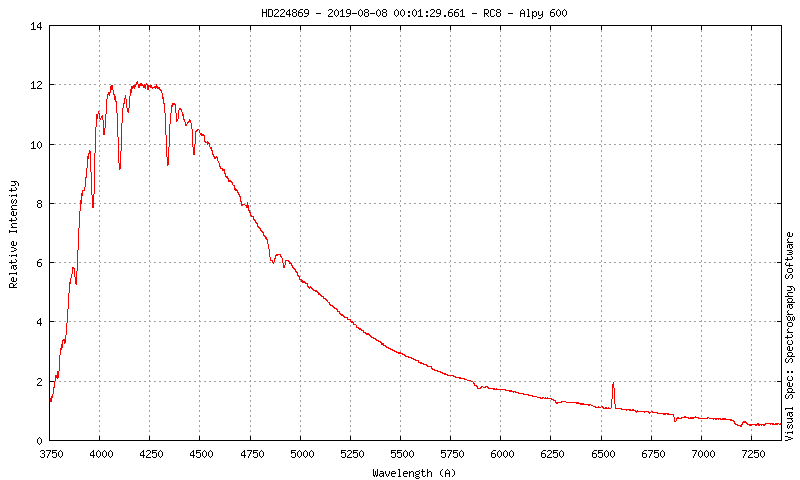
HD224869
A B2ne-type Be star, the visual companion of WZ Cas (magnitude 8.4, separated by 58″), but with no established physical link to it: their radial-velocity difference, about 20 km/s, rules out a gravitationally bound pair — it is only an optical double. Its low-resolution spectrum shows emission on Hα, Hβ and Hγ, the signature of a forming circumstellar disc, making it an interesting Be target in its own right, beyond its role as a field neighbour of WZ Cas.
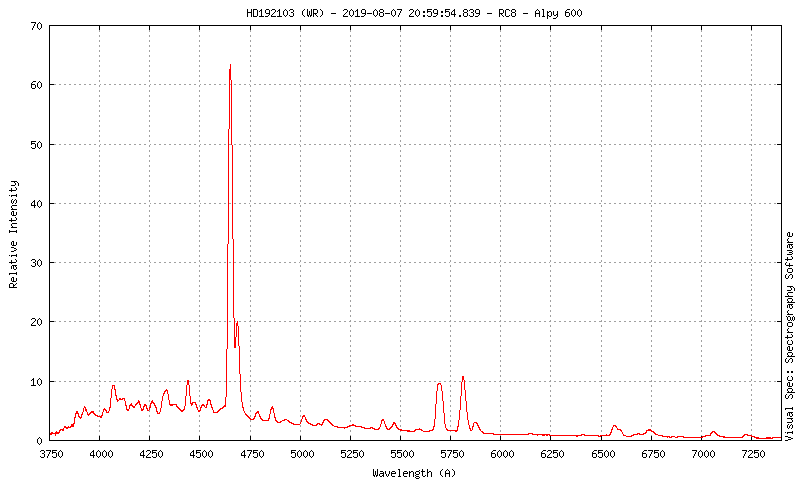
HD192103
A carbon-rich WC8-type Wolf-Rayet star, considered single (no massive companion detected). Its low-resolution spectrum shows the broad emission lines of carbon and helium characteristic of the WC sequence, and it is known for rapid line-profile variability, reflecting instabilities in its dense stellar wind.
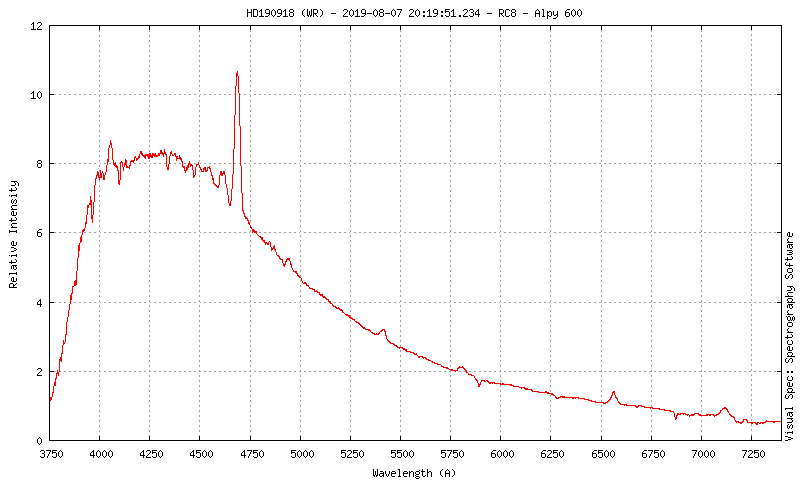
HD190918 - WR133
A WN4.5-type Wolf-Rayet star in a colliding-wind binary with an O9.5 supergiant companion. Its low-resolution spectrum is dominated by broad helium and nitrogen emission lines (HeII, NIII/NIV), typical of the WN sequence, with variations linked to the shock region between the two winds.
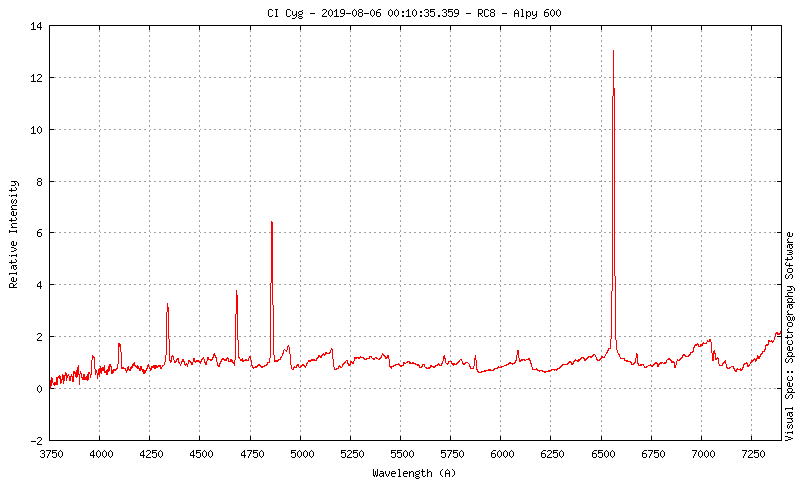
CI Cyg
A symbiotic star in Cygnus, an eclipsing binary pairing a cool red giant with a very hot accreting white dwarf. Its low-resolution spectrum combines the molecular (TiO) bands of the cool giant with strong emission lines (hydrogen, ionized helium) from the hot region, varying with its outburst episodes.
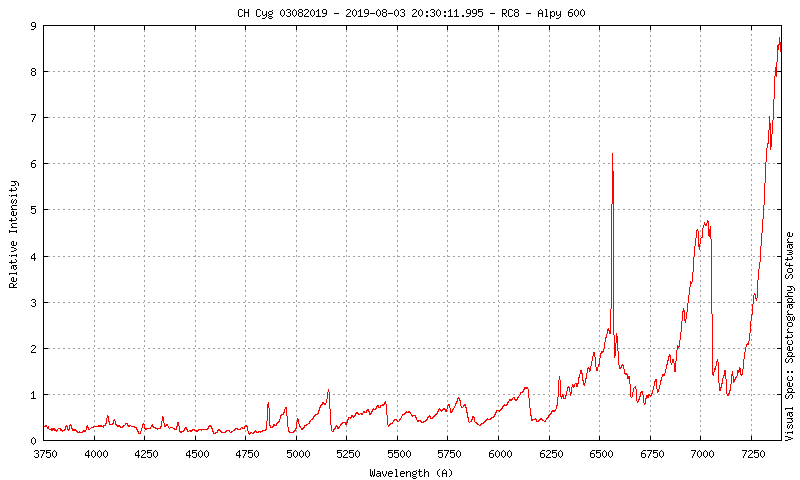
CH Cyg
One of the closest and most studied symbiotic stars, pairing a red giant with a white dwarf. Extremely variable, it has produced collimated jets observed in radio and optical light. Its low-resolution spectrum, part cool (molecular bands) and part hot (emission lines), changes dramatically from one active episode to the next.
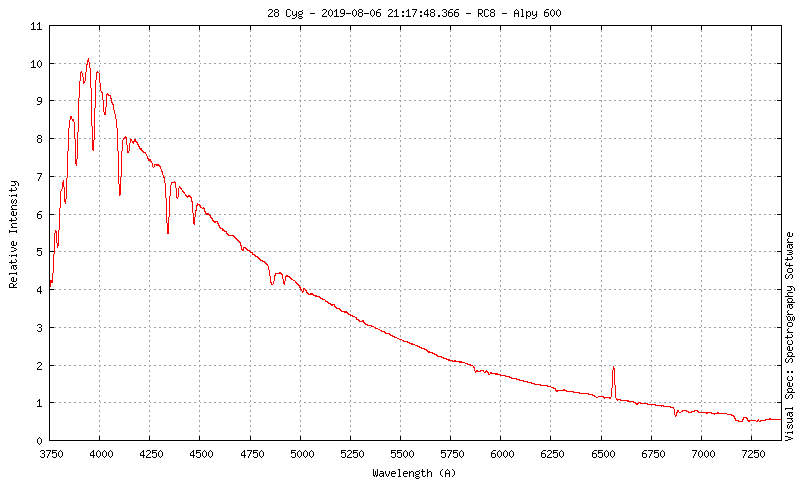
28 Cyg - V1624 Cyg
A Be star in Cygnus, a non-radial pulsator and spectroscopic binary. Its low-resolution spectrum shows Hα in emission, whose strength varies as its circumstellar disc forms and dissipates, offering an excellent way to track Be-star activity over time.
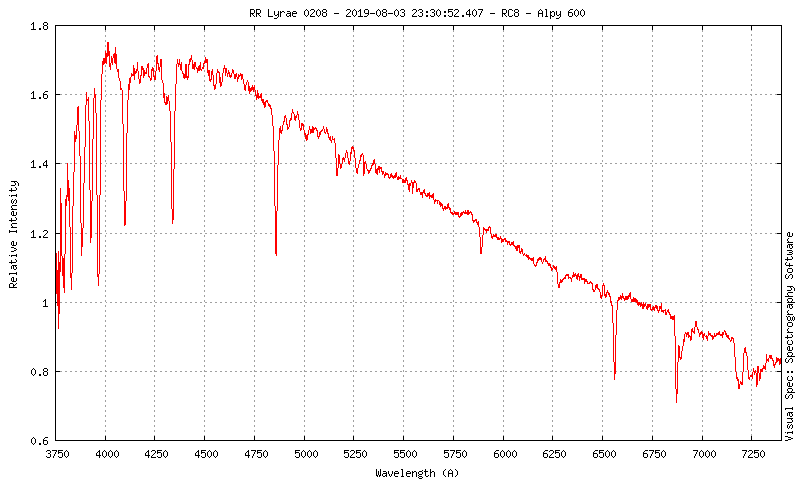
RR Lyrae
The prototype pulsating horizontal-branch variable, with a period of about 13.6 hours. Its low-resolution spectral type shifts (A to F) over the pulsation cycle, and the radial velocity derived from the line shift directly traces the motion of its surface. RR Lyrae itself shows the Blazhko effect, a still poorly understood modulation of its pulsation amplitude and phase.
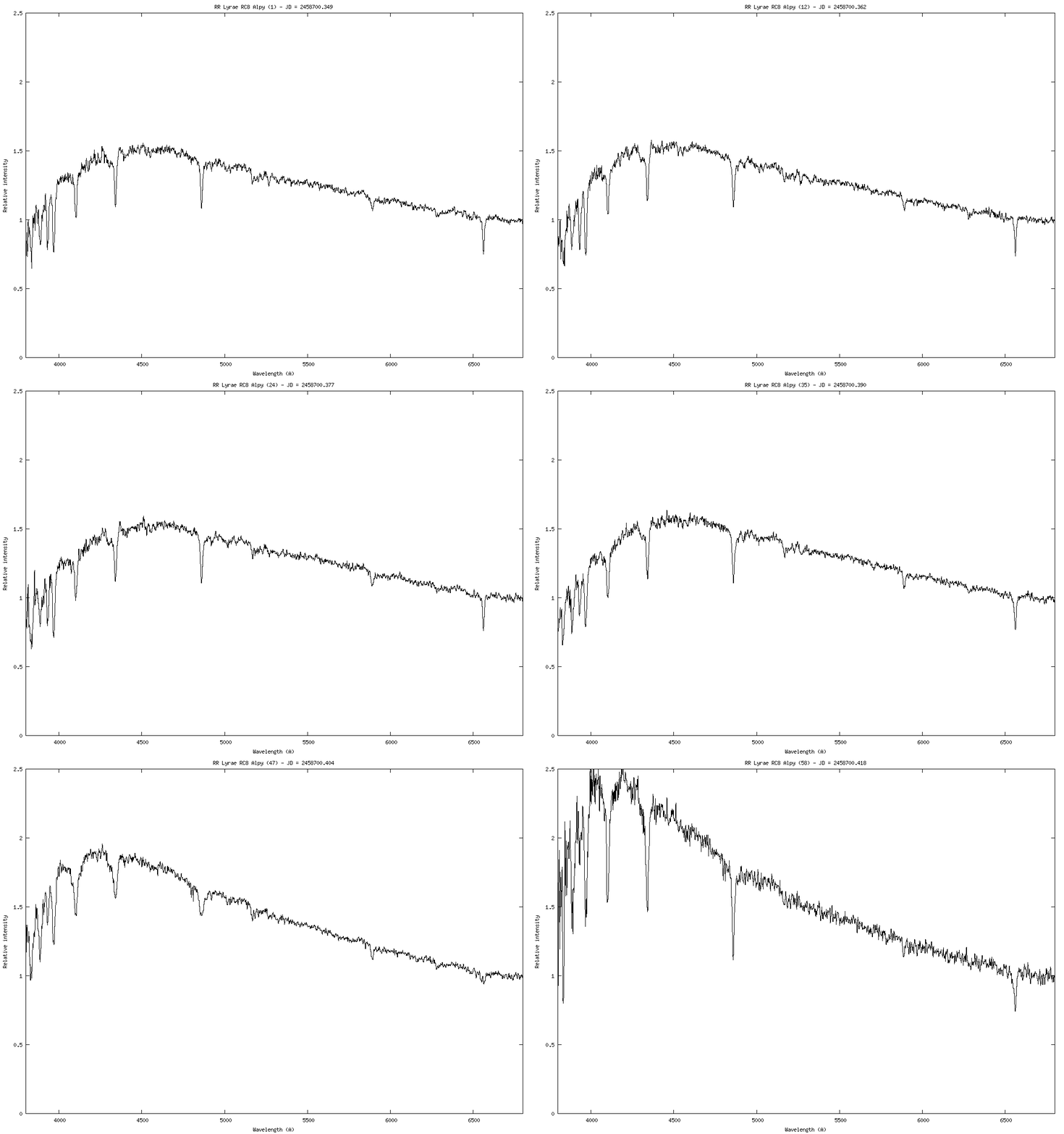
RR Lyrae – Pulsation animation (7 August 2019)
A series of low-resolution spectra taken across a full pulsation cycle, animated to show in real time the shifting of the lines (Doppler shift) and the changing spectral type of the star. A vivid way to “watch” a pulsating star beat, using an amateur spectrograph.